Sunday, February 6, 2011

Mother Teresa


Mother Teresa (26 August 1910 – 5 September 1997), born Agnes Gonxha Bojaxhiu (pronounced [aɡˈnɛs ˈɡɔndʒa bɔjaˈdʒiu]), was a Catholic nun of Albanian ethnicity and Indian citizenship, who founded the Missionaries of Charity in Calcutta, India in 1950. For over 45 years she ministered to the poor, sick, orphaned, and dying, while guiding the Missionaries of Charity's expansion, first throughout India and then in other countries. Following her death she was beatified by Pope John Paul II and given the title Blessed Teresa of Calcutta.
By the 1970s, she was internationally famed as a humanitarian and advocate for the poor and helpless, due in part to a documentary and book Something Beautiful for God by Malcolm Muggeridge. She won the Nobel Peace Prize in 1979 and India's highest civilian honour, the Bharat Ratna, in 1980 for her humanitarian work. Mother Teresa's Missionaries of Charity continued to expand, and at the time of her death it was operating 610 missions in 123 countries, including hospices and homes for people with HIV/AIDS, leprosy and tuberculosis, soup kitchens, children's and family counselling programs, orphanages, and schools.
    She has been praised by many individuals, governments and organizations; however, she has also faced a diverse range of criticism. These include objections by various individuals and groups, including Christopher Hitchens, Michael Parenti, Aroup Chatterjee, Vishva Hindu Parishad, against the proselytizing focus of her work including a strong stance against contraception and abortion, a belief in the spiritual goodness of poverty and alleged baptisms of the dying. Medical journals also criticised the standard of medical care in her hospices and concerns were raised about the opaque nature in which donated money was spent. In 2010 on the 100th anniversary of her birth, she was honoured around the world, and her work praised by Indian President Pratibha Patil.

Early life

Agnes Gonxha Bojaxhiu (gonxha meaning "rosebud" or "little flower" in Albanian) was born on 26 August 1910, in Üsküb, Ottoman Empire (now Skopje, capital of the Republic of Macedonia). Although she was born on 26 August, she considered 27 August, the day she was baptized, to be her "true birthday." She was the youngest of the children of a family from Shkodër, Albania, born to Nikollë and Drana Bojaxhiu. Her father, who was involved in Albanian politics, died in 1919 when she was eight years old. After her father's death, her mother raised her as a Roman Catholic. Her father, Nikollë Bojaxhiu (his name means 'painter') was of Kosovar Albanian origin possibly stemming from Prizren, Kosovo while her mother's origin was possibly from a village near Đakovica, Kosovo.
       According to a biography by Joan Graff Clucas, in her early years Agnes was fascinated by stories of the lives of missionaries and their service in Bengal, and by age 12 was convinced that she should commit herself to a religious life. Her final resolution was taken on August 15, 1928, while praying at the shrine of the Black Madonna of Letnice, where she often went on pilgrimage.She left home at age 18 to join the Sisters of Loreto as a missionary. She never again saw her mother or sister.
       Agnes initially went to the Loreto Abbey in Rathfarnham, Ireland to learn English, the language the Sisters of Loreto used to teach school children in India. She arrived in India in 1929, and began her novitiate in Darjeeling, near the Himalayan mountains, where she learnt Bengali and taught at the St. Teresa’s School, a schoolhouse close to her convent. She took her first religious vows as a nun on 24 May 1931. At that time she chose to be named after Thérèse de Lisieux, the patron saint of missionaries, but because one nun in the convent had already chosen that name, Agnes opted for the Spanish spelling Teresa.
      She took her solemn vows on 14 May 1937, while serving as a teacher at the Loreto convent school in Entally, eastern Calcutta. Teresa served there for almost twenty years and in 1944 was appointed headmistress.
      Although Teresa enjoyed teaching at the school, she was increasingly disturbed by the poverty surrounding her in Calcutta. The Bengal famine of 1943 brought misery and death to the city; and the outbreak of Hindu/Muslim violence in August 1946 plunged the city into despair and horror.

Miracle and beatification

After Mother Teresa's death in 1997, the Holy See began the process of beatification, the third step toward possible canonization. This process requires the documentation of a miracle performed from the intercession of Mother Teresa.
       In 2002, the Vatican recognized as a miracle the healing of a tumor in the abdomen of an Indian woman, Monica Besra, after the application of a locket containing Mother Teresa's picture. Besra said that a beam of light emanated from the picture, curing the cancerous tumor. Critics—including some of Besra's medical staff and, initially, Besra's husband—insisted that conventional medical treatment had eradicated the tumor. Dr. Ranjan Mustafi, who told The New York Times he had treated Besra, said that the cyst was not cancer at all but a cyst caused by tuberculosis. He insisted, "It was not a miracle.... She took medicines for nine months to one year." According to Besra’s husband, “My wife was cured by the doctors and not by any miracle.”
     An opposing perspective of the claim is that Besra's medical records contain sonograms, prescriptions, and physicians' notes that could prove whether the cure was a miracle or not. Besra has claimed that Sister Betta of the Missionaries of Charity is holding them. The publication has received a "no comments" statement from Sister Betta. The officials at the Balurghat Hospital where Besra was seeking medical treatment have claimed that they are being pressured by the Catholic order to declare the cure a miracle.
Christopher Hitchens was the only witness called by the Vatican to give evidence against Mother Teresa's beatification and canonization process, because the Vatican had abolished the traditional "devil's advocate" role, which fulfilled a similar purpose. Hitchens has argued that "her intention was not to help people," and he alleged that she lied to donors about the use of their contributions. “It was by talking to her that I discovered, and she assured me, that she wasn't working to alleviate poverty,” says Hitchens. “She was working to expand the number of Catholics. She said, ‘I'm not a social worker. I don't do it for this reason. I do it for Christ. I do it for the church.’”
     In the process of examining Teresa's suitability for beatification and canonization, the Roman Curia (the Vatican) pored over a great deal of documentation of published and unpublished criticism of her life and work. Vatican officials say Hitchens's allegations have been investigated by the agency charged with such matters, the Congregation for the Causes of Saints, and they found no obstacle to Mother Teresa's beatification. Because of the attacks she has received, some Catholic writers have called her a sign of contradiction. The beatification of Mother Teresa took place on 19 October 2003, thereby bestowing on her the title "Blessed." A second miracle is required for her to proceed to canonization.


Mohandas Karamchand Gandhi

Mohandas Karamchand Gandhi (Gujarati: મોહનદાસ કરમચંદ ગાંધી; Hindi: मोहनदास करमचंद गांधी, pronounced [moːɦənd̪aːs kərəmtɕənd̪ ɡaːnd̪ʱi]; 2 October 1869 – 30 January 1948) was the pre-eminent political and ideological leader of India during the Indian independence movement. He pioneered satyagraha. This is defined as resistance to tyranny through mass civil disobedience, a philosophy firmly founded upon ahimsa, or total nonviolence. This concept helped India to gain independence, and inspired movements for civil rights and freedom across the world. Gandhi is often referred to as Mahatma Gandhi ([məɦaːt̪maː]; Sanskrit: महात्मा mahātmā or "Great Soul", an honorific first applied to him by Rabindranath Tagore). In India he is also called Bapu (Gujarati: બાપુ, bāpu or "Father"). He is officially honoured in India as the Father of the Nation; his birthday, 2 October, is commemorated there as Gandhi Jayanti, a national holiday, and worldwide as the International Day of Non-Violence. Gandhi was assassinated on 30 January 1948 by Nathuram Godse, a Hindu Nationalist.
      Gandhi first employed civil disobedience while an expatriate lawyer in South Africa, during the resident Indian community's struggle there for civil rights. After his return to India in 1915, he organised protests by peasants, farmers, and urban labourers concerning excessive land-tax and discrimination. After assuming leadership of the Indian National Congress in 1921, Gandhi led nationwide campaigns to ease poverty, expand women's rights, build religious and ethnic amity, end untouchability, and increase economic self-reliance. Above all, he aimed to achieve Swaraj or the independence of India from foreign domination. Gandhi famously led his followers in the Non-cooperation movement that protested the British-imposed salt tax with the 400 km (240 mi) Dandi Salt March in 1930. Later, in 1942, he launched the Quit India civil disobedience movement demanding immediate independence for India. Gandhi spent a number of years in jail in both South Africa and India.
       As a practitioner of ahimsa, Gandhi swore to speak the truth and advocated that others do the same. He lived modestly in a self-sufficient residential community and wore the traditional Indian dhoti and shawl, woven from yarn that he had spun by hand himself. He ate simple vegetarian food, experimented for a time with a fruitarian diet, and undertook long fasts as a means of both self-purification and social protest.
Mohandas Karamchand Gandhi was born on 2 October 1869 in Porbandar, a coastal town which was then part of the Bombay Presidency, British India. His father, Karamchand Gandhi (1822–1885), who belonged to the Hindu Modh community, served as the diwan (a high official) of Porbander state, a small princely state in the Kathiawar Agency of British India. His grandfather was Uttamchand Gandhi, fondly called Utta Gandhi. His mother, Putlibai, who came from the Hindu Pranami Vaishnava community, was Karamchand's fourth wife, the first three wives having apparently died in childbirth. Growing up with a devout mother and the Jain traditions of the region, the young Mohandas absorbed early the influences that would play an important role in his adult life; these included compassion for sentient beings, vegetarianism, fasting for self-purification, and mutual tolerance between individuals of different creeds.
         The Indian classics, especially the stories of Shravana and Maharaja Harishchandra from the Indian epics, had a great impact on Gandhi in his childhood. The story of Harishchandra, a well-known tale of an ancient Indian king and a truthful hero, haunted Gandhi as a boy. Gandhi in his autobiography admits that it left an indelible impression on his mind. He writes: "It haunted me and I must have acted Harishchandra to myself times without number." Gandhi's early self-identification with Truth and Love as supreme values is traceable to his identification with these epic characters.
        In May 1883, the 13-year old Mohandas was married to 14-year old Kasturbai Makhanji (her first name was usually shortened to "Kasturba", and affectionately to "Ba") in an arranged child marriage, according to the custom of the region. Recalling the day of their marriage he once said that, "As we didn't know much about marriage, for us it meant only wearing new clothes, eating sweets and playing with relatives." However, as was also the custom of the region, the adolescent bride was to spend much time at her parents' house, and away from her husband. In 1885, when Gandhi was 15, the couple's first child was born, but survived only a few days; Gandhi's father, Karamchand Gandhi, had died earlier that year. Mohandas and Kasturba had four more children, all sons: Harilal, born in 1888; Manilal, born in 1892; Ramdas, born in 1897; and Devdas, born in 1900. At his middle school in Porbandar and high school in Rajkot, Gandhi remained an average student academically. He passed the matriculation exam for Samaldas College at Bhavnagar, Gujarat with some difficulty. While there, he was unhappy, in part because his family wanted him to become a barrister.
      On 4 September 1888, less than a month shy of his 19th birthday, Gandhi travelled to London, England, to study law at University College London and to train as a barrister. His time in London, the Imperial capital, was influenced by a vow he had made to his mother in the presence of the Jain monk Becharji, upon leaving India, to observe the Hindu precepts of abstinence from meat, alcohol, and promiscuity. Although Gandhi experimented with adopting "English" customs—taking dancing lessons for example—he could not stomach the bland vegetarian food offered by his landlady and he was always hungry until he found one of London's few vegetarian restaurants. Influenced by Salt's book, he joined the Vegetarian Society, was elected to its executive committee, and started a local Bayswater chapter. Some of the vegetarians he met were members of the Theosophical Society, which had been founded in 1875 to further universal brotherhood, and which was devoted to the study of Buddhist and Hindu literature. They encouraged Gandhi to join them in reading the Bhagavad Gita both in translation as well as in the original. Not having shown a particular interest in religion before, he became interested in religious thought and began to read both Hindu as well as Christian scriptures.
       Gandhi was called to the bar on 10 June 1891 and left London for India on 12 June 1891, where he learned that his mother had died while he was in London, his family having kept the news from him. His attempts at establishing a law practice in Bombay failed and, later, after applying and being turned down for a part-time job as a high school teacher, he ended up returning to Rajkot to make a modest living drafting petitions for litigants, a business he was forced to close when he ran foul of a British officer. In his autobiography he refers to this incident as an unsuccessful attempt to lobby on behalf of his older brother. It was in this climate that, in April 1893, he accepted a year-long contract from Dada Abdulla & Co., an Indian firm, to a post in the Colony of Natal, South Africa, then part of the British Empire.

Thursday, February 3, 2011

Adolf Hitler

(German pronunciation: [ˈadɔlf ˈhɪtlɐ]; 20 April 1889 – 30 April 1945) was an Austrian-born German politician and the leader of the National Socialist German Workers Party(German: Nationalsozialistische Deutsche Arbeiterpartei, abbreviated NSDAP), commonly known as the Nazi Party. He was Chancellor of Germany from 1933 to 1945, and served ashead of state as Führer und Reichskanzler from 1934 to 1945.
          A decorated veteran of World War I, Hitler joined the precursor of the Nazi Party (DAP) in 1919, and became leader of NSDAP in 1921. He attempted a failed coup d'etat known as the Beer Hall Putsch, which occurred at the Bürgerbräukeller beer hall in Munich on November 8–9, 1923. Hitler was imprisoned for one year due to the failed coup, and wrote his memoir, "My Struggle" (in German Mein Kampf), while imprisoned. After his release on December 20, 1924, he gained support by promoting Pan-Germanism, anti-semitism, anti-capitalism, and anti-communism with charismatic oratory and propaganda. He was appointed chancellor on January 30, 1933, and transformed the Weimar Republic into the Third Reich, a single-party dictatorshipbased on the totalitarian and autocratic ideology of Nazism.
           Hitler ultimately wanted to establish a New Order of absolute Nazi German hegemony in continental Europe. To achieve this, he pursued a foreign policy with the declared goal of seizing Lebensraum ("living space") for the Aryan people; directing the resources of the state towards this goal. This included the rearmament of Germany, which culminated in 1939 when the Wehrmacht invaded Poland. In response, the United Kingdom and France declared war against Germany, leading to the outbreak of World War II in Europe.
           Within three years, German forces and their European allies had occupied most of Europe, and most of Northern Africa, and the Japanese forces had occupied parts of East and Southeast Asia and the Pacific Ocean. However, with the reversal of the Nazi invasion of the Soviet Union, the Allies gained the upper hand from 1942 onwards. By 1944, Allied armies had invaded German-held Europe from all sides. Nazi forces engaged in numerous violent acts during the war, including the systematic murder of as many as 17 million civilians, including an estimated six million Jews targeted in the Holocaust and between 500,000 and 1,500,000Roma, added to the Poles, Soviet civilians, Soviet prisoners of war, people with disabilities, homosexuals, Jehovah's Witnesses, and other political and religious opponents.
            In the final days of the war, during the Battle of Berlin in 1945, Hitler married his long-time mistress Eva Braun and, to avoid capture by Soviet forces, the two committed suicide less than two days later on 30 April 1945. 
            

Ancestry

Hitler's father, Alois Hitler, was an illegitimate child of Maria Anna Schicklgruber, so his paternity was not listed on his birth certificate; he bore his mother's surname. In 1842, Johann Georg Hiedler married Maria and in 1876 Alois testified before a notary and three witnesses that Johann was his father. Despite this testimony, Alois' paternity has been the subject of controversy. After receiving a "blackmail letter" from Hitler's nephew William Patrick Hitler threatening to reveal embarrassing information about Hitler's family tree, Nazi Party lawyer Hans Frank investigated, and, in his memoirs, claimed to have uncovered letters revealing that Alois' mother was employed as a housekeeper for a Jewish family in Graz and that the family's 19-year-old son, Leopold Frankenberger, fathered Alois. No evidence had, at that time, ever been produced to support Frank's claim, and Frank himself said Hitler's full Aryan blood was obvious. Frank's claims were widely believed in the 1950s, but by the 1990s, were generally doubted by historians. Ian Kershaw dismissed the Frankenberger story as a "smear" by Hitler's enemies, noting that all Jews had been expelled from Graz in the 15th century and were not allowed to return until well after Alois was born.
       At age 39, Alois took the surname Hitler. This surname was variously spelled Hiedler, Hüttler, Huettler and Hitler, and was probably regularized to Hitler by a clerk. The origin of the name is either "one who lives in a hut" (Standard German Hütte), "shepherd" (Standard German hüten "to guard", English heed), or is from the Slavic word Hidlar and Hidlarcek.
       

Childhood

Adolf Hitler was born at around 6:30 p.m. on 20 April 1889 at the Gasthof zum Pommer, an inn in Braunau am Inn, Austria–Hungary, the fourth of six children to Alois Hitler and Klara P
         His father's efforts at Hafeld ended in failure, and the family relocated to Lambach in 1897. Hitler attended  a Catholic school located in an 11th-century Benedictine cloister, where the walls were engraved in a number of places with crests containing the symbol of the swastika. It was in Lambach that the eight-year-old Hitler sang in the church choir, took singing lessons, and even entertained the fantasy of one day becoming a priest. In 1898, the family returned permanently to Leonding.When he was three years old, his family relocated to Kapuzinerstrasse 5 in Passau, Germany, where Hitler would acquire Lower Bavarian rather than Austrian as his lifelong native dialect. In 1894, the family relocated to Leonding near Linz, then in June 1895, Alois retired to a small landholding at Hafeld nearLambach, where he tried his hand at farming and beekeeping. During this time, the young Hitler attended school in nearby Fischlham. As a child, he played "Cowboys and Indians" and, by his own account, became fixated on war after finding a picture book about the Franco-Prussian War among his father's belongings.
       His younger brother Edmund died of measles on 2 February 1900, causing permanent changes in Hitler. He went from a confident, outgoing boy who excelled in school, to a morose, detached, sullen boy who constantly battled his father and his teachers.
      Hitler was attached to his mother, though he had a troubled relationship with his father, who frequently beat him, especially in the years after Alois' retirement and disappointing farming efforts. Alois wanted his son to follow in his footsteps as an Austrian customs official, and this became a huge source of conflict between them. Despite his son's pleas to go to classical high school and become an artist, his father sent him to the Realschule in Linz, a technical high school of about 300 students, in September 1900. Hitler rebelled, and in Mein Kampf confessed to failing his first year in hopes that once his father saw "what little progress I was making at the technical school he would let me devote myself to the happiness I dreamed of." Alois never relented, however, and Hitler became even more bitter and rebellious.
     German Nationalism quickly became an obsession for Hitler, and a way to rebel against his father, who proudly served the Austrian government. Most people who lived along the German-Austrian border considered themselves German-Austrians, but Hitler expressed loyalty only to Germany. In defiance of the Austrian monarchy, and his father who continually expressed loyalty to it, Hitler and his young friends liked to use the German greeting "Heil", and sing the German anthem "Deutschland Über Alles" instead of the Austrian Imperial anthem.
After Alois' sudden death on 3 January 1903, Hitler's behaviour at the technical school became even more disruptive, and he was asked to leave. He enrolled at the Realschule in Steyr in 1904, but upon completing his second year, he and his friends went out for a night of celebration and drinking, and an intoxicated Hitler tore his school certificate into four pieces and used it as toilet paper. When someone turned the stained certificate in to the school's director, he "... gave him such a dressing-down that the boy was reduced to shivering jelly. It was probably the most painful and humiliating experience of his life." Hitler was expelled, never to return to school again.
At age 15, Hitler took part in his First Holy Communion on Whitsunday, 22 May 1904, at the Linz Cathedral.His sponsor was Emanuel Lugert, a friend of his late father.

Early adulthood in Vienna and Munich

From 1905 on, Hitler lived a bohemian life in Vienna on an orphan's pension and support from his mother. He was rejected twice by theAcademy of Fine Arts Vienna (1907–1908), citing "unfitness for painting", and was told his abilities lay instead in the field of architecture.Following the school rector's recommendation, he too became convinced this was his path to pursue, yet he lacked the proper academic preparation for architecture school:
In a few days I myself knew that I should some day become an architect. To be sure, it was an incredibly hard road; for the studies I had neglected out of spite at the Realschule were sorely needed. One could not attend the Academy's architectural school without having attended the building school at the Technic, and the latter required a high-school degree. I had none of all this. The fulfillment of my artistic dream seemed physically impossible.

     Hitler said he first became an anti-Semite in Vienna,
 which had a large Jewish community, including Orthodox Jews who had fled the pogroms in Russia. According to childhood friendAugust Kubizek, however, Hitler was a "confirmed anti-Semite" before he left Linz. Vienna at that time was a hotbed of traditional religious prejudice and 19th century racism. Hitler may have been influenced by the occult writings of the anti-Semite Lanz von Liebenfels in his magazineOstara; it is usually taken for granted that he read the publication (he recounts in Mein Kampf his conversion to anti-semitism being after reading some pamphlets) and he most likely did read it, although it is uncertain to what degree he was influenced by the anti-semitic occult work.
On 21 December 1907, Hitler's mother died of breast cancer at age 47. Ordered by a court in Linz, Hitler gave his share of the orphans' benefits to his sister Paula. When he was 21, he inherited money from an aunt. He struggled as a painter in Vienna, copying scenes from postcards and selling his paintings to merchants and tourists. After being rejected a second time by the Academy of Arts, Hitler ran out of money. In 1909, he lived in a shelter for the homeless. By 1910, he had settled into a house for poor working men on Meldemannstraße. Another resident of the house, Reinhold Hanisch, sold Hitler's paintings until the two men had a bitter falling-out.
There were very few Jews in Linz. In the course of centuries the Jews who lived there had become Europeanised in external appearance and were so much like other human beings that I even looked upon them as Germans. The reason why I did not then perceive the absurdity of such an illusion was that the only external mark which I recognized as distinguishing them from us was the practice of their strange religion. As I thought that they were persecuted on account of their faith my aversion to hearing remarks against them grew almost into a feeling of abhorrence. I did not in the least suspect that there could be such a thing as a systematic antisemitism. Once, when passing through the inner City, I suddenly encountered a phenomenon in a long caftan and wearing black side-locks. My first thought was: Is this a Jew? They certainly did not have this appearance in Linz. I carefully watched the man stealthily and cautiously but the longer I gazed at the strange countenance and examined it feature by feature, the more the question shaped itself in my brain: Is this a German?
      If this account is true, Hitler apparently did not act on his new belief. He often was a guest for dinner in a noble Jewish house, and he interacted well with Jewish merchants who tried to sell his paintings.
     Hitler may also have been influenced by Martin Luther's On the Jews and their Lies. In Mein Kampf, Hitler refers to Martin Luther as a great warrior, a true statesman, and a great reformer, alongside Richard Wagner and Frederick the Great. Wilhelm Röpke, writing after the Holocaust, concluded that "without any question, Lutheranism influenced the political, spiritual and social history of Germany in a way that, after careful consideration of everything, can be described only as fateful."
      Hitler claimed that Jews were enemies of the Aryan race. He held them responsible for Austria's crisis. He also identified certain forms ofsocialism and Bolshevism, which had many Jewish leaders, as Jewish movements, merging his antisemitism with anti-Marxism. Later, blaming Germany's military defeat in World War I on the 1918 revolutions, he considered Jews the culprits of Imperial Germany's downfall and subsequent economic problems as well.
         Hitler received the final part of his father's estate in May 1913 and moved to Munich. He wrote in Mein Kampf that he had always longed to live in a "real" German city. In Munich, he became more interested in architecture and, he says, the writings of Houston Stewart Chamberlain. Moving to Munich also helped him escape military service in Austria for a time, but the Munich police (acting in cooperation with the Austrian authorities) eventually arrested him. After a physical exam and a contrite plea, he was deemed unfit for service and allowed to return to Munich. However, when Germany entered World War I in August 1914, he petitioned King Ludwig III of Bavaria for permission to serve in a Bavarian regiment. This request was granted, and Adolf Hitler enlisted in the Bavarian army.
            

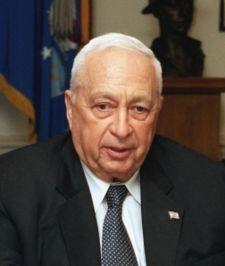
Ariel Sharon


also known by his diminutive Arik, אַריק, born Ariel Scheinermann, אריאל שיינרמן on 26 February 1928) is an Israeli statesman and retired general, who served as Israel’s 11th Prime Minister. He is currently in a permanent vegetative state after suffering a stroke on 4 January 2006.
         Sharon was a commander in the Israeli Army since its inception in 1948. He participated in the1948 War of Independence, 1956 Suez War, Six-Day War of 1967, and the Yom-Kippur War of 1973. After retiring from the army, Sharon joined the right-wing Likud party, and served in a number of ministerial posts in Likud-led governments in 1977-1992 and 1996-1999. He became the leader of the Likud in 2000, and served as Israel’s Prime Minister from 2001 to 2006.
         During his long military and political career, Sharon was considered a controversial and polarizing figure. In 1983 a commission established by the Israeli Government found that asMinister of Defense during the 1982 Lebanon War Sharon bore personal, but indirect, responsibility for the massacre by Lebanese militias of Palestinian civilians in the refugee camps of Sabra and Shatila. His actions during this conflict led to calls for him to be tried as a war criminal for the slaughter of thousands of innocent people. In 1970s, 1980s and 1990s Sharon championed construction of Israeli settlements in the West Bank and Gaza Strip. However, as Prime Minister, in 2004-2005 Sharon orchestrated Israel's unilateral disengagement from the Gaza Strip. Facing stiff opposition to this policy within the Likud, in November 2005 he left Likud to form a new Kadima party. In January 2006 Sharon suffered a major stroke that left him in a permanent vegetative state. In March 2006 elections, Kadima, led by Ehud Olmert following Sharon's stroke, went on to win plurality of Knesset seats, becoming the senior coalition partner in Israel's 31st government.
          Sharon was born in Kfar Malal, then in the British Mandate of Palestine, to a family of Lithuanian Jews - Shmuel Sheinerman, of Brest-Litovsk (now Brest, Belarus) and Dvora (formerly Vera), of Mogilev. His father was studying agronomy at the university of Tbilisi, Georgia (Georgian SSR) and his mother had just started her fourth year of medical studies when the couple married. They immigrated to the British Mandate Palestine from Russia, fleeing the early Pogroms associated with the Bolshevik Revolution. Apart from Hebrew, Sharon's father spoke Yiddishand his mother spoke Russian; their son also learned to speak Russian as a young boy.
The family arrived in the Second Aliyah and settled in a socialist, secular community where, despite being Mapai supporters, they were known to be contrarians against the prevailing community consensus:
The Scheinermans' eventual ostracism... followed the 1933 Arlozorov murder when Dvora and Shmuel refused to endorse the Labor movement's anti-Revisionist calumny and participate in Bolshevic-style public revilement rallies, then the order of the day. Retribution was quick to come. They were expelled from the local health-fund clinic and village synagogue. The cooperative's truck wouldn't make deliveries to their farm nor collect produce.
Four years after their arrival at Kfar Malal, the Sheinermans had a daughter, Yehudit (Dita), and two years after, they had a son, Ariel. At age 10, Sharon entered the Zionist youth movement Hassadeh. In 1942 at the age of 14, Sharon joined the Gadna, a paramilitary youth battalion, and later the Haganah, the underground paramilitary force and the Jewish military precursor to the Israel Defense Forces (IDF).
         At the creation of Israel (and Haganah's transformation into the Israel Defense Forces), Sharon became aplatoon commander in the Alexandroni Brigade. He was severely wounded in the groin by the Jordanian Arab Legion in the first Battle of Latrun, an unsuccessful attempt to relieve the besieged Jewish community ofJerusalem. In September 1949, Sharon was promoted to company commander (of the Golani Brigade's reconnaissance unit) and in 1950 to intelligence officer for Central Command. He then took leave to begin studies in history and Middle Eastern culture at the Hebrew University of Jerusalem. A year and a half later, he was asked to return to active service in the rank of major and as the leader of the new Unit 101, Israel's firstspecial forces unit.
           Unit 101 undertook a series of military raids against Palestinians and neighboring Arab states that helped bolster Israeli morale and fortify its deterrent image. The unit was known for raids against Arab civilians and military,notably in the widely condemned Qibya massacre in the fall of 1953, in which 69 Palestinian civilians, some of them children, were killed by Sharon's troops in a reprisal attack on their West Bank village. In the documentary Israel and the Arabs: 50 Year War, Sharon recalls what happened after the raid, which was heavily condemned by many Western nations, including the U.S.:
I was summoned to see Ben-Gurion. It was the first time I met him, and right from the start Ben-Gurion said to me: "Let me first tell you one thing: it doesn't matter what the world says about Israel, it doesn't matter what they say about us anywhere else. The only thing that matters is that we can exist here on the land of our forefathers. And unless we show the Arabs that there is a high price to pay for murdering Jews, we won't survive."
          A few months after its founding, Unit 101 was merged with the 890 Paratroopers Battalion to create the Paratroopers Brigade (Sharon eventually became the latter's commander). It continued to attack military, culminating with the attack on the Qalqilyah police station in the autumn of 1956.
In 1952-53, Sharon attended the Hebrew University of Jerusalem, taking History and Oriental studies.
         Sharon was widowed twice. Shortly after becoming a military instructor, he married Margalit, with whom he had a son, Gur. Margalit died in acar accident in May 1962. Their son, Gur, died in October 1967 after a friend accidentally shot him while they were playing with a rifle.After Margalit's death, Sharon married her younger sister, Lily. They had two sons, Omri and Gil'ad. Lily Sharon died of cancer in 2000.
        From 1958 to 1962, Sharon served as commander of an infantry brigade and studied law at Tel Aviv University.

Mitla incident

In the 1956 Suez War (the British "Operation Musketeer"), Sharon commanded Unit 202 (the Paratroopers Brigade), and was responsible for taking ground east of the Sinai's Mitla Pass and eventually taking the pass itself. Having successfully carried out the first part of his mission (joining a battalion parachuted near Mitla with the rest of the brigade moving on ground), Sharon's unit was deployed near the pass. Neitherreconnaissance aircraft nor scouts reported enemy forces inside the Mitla Pass. Sharon, whose forces were initially heading east, away from the pass, reported to his superiors that he was increasingly concerned with the possibility of an enemy thrust through the pass, which could attack his brigade from the flank or the rear.
        Sharon asked for permission to attack the pass several times, but his requests were denied, though he was allowed to check its status so that if the pass was empty, he could receive permission to take it later. Sharon sent a small scout force, which was met with heavy fire and became bogged down due to vehicle malfunction in the middle of the pass. Sharon ordered the rest of his troops to attack in order to aid their comrades. In the ensuing successful battle to capture the pass, 38 Israeli soldiers were killed. Sharon was criticized by his superiors and he was damaged by allegations several years later made by several former subordinates, who claimed that Sharon tried to provoke theEgyptians and sent out the scouts in bad faith, ensuring that a battle would ensue.

Six-Day War and Yom Kippur War
The Mitla incident hindered Sharon's military career for several years. In the meantime, he occupied the position of an infantry brigadecommander and received a law degree from Tel Aviv University. However, when Yitzhak Rabin became Chief of Staff in 1964, Sharon began again to rise rapidly in the ranks, occupying the positions of Infantry School Commander and Head of Army Training Branch, eventually achieving the rank of Aluf (Major General). In the 1967 Six-Day War, Sharon commanded the most powerful armored division on the Sinaifront which made a breakthrough in the Kusseima-Abu-Ageila fortified area (see Battle of Abu-Ageila). In 1969, he was appointed the Head of IDF's Southern Command. He had no further promotions before retiring in August 1973. Soon after, he joined the Likud ("Unity") political party.
        At the start of the Yom Kippur War on 6 October 1973, Sharon was called back to active duty along with his assigned reserve armored division. His forces did not engage the Egyptian Army immediately, despite his requests. Under cover of darkness Sharon's forces moved to a point on the Suez Canal that had been prepared before the war. Bridging equipment was thrown across the canal on 17 October. Thebridgehead was between two Egyptian Armies. He then headed north towards Ismailia, intent on cutting the Egyptian second army's supply lines, but his division was halted south of the Fresh Water Canal.
        Abraham (Bren) Adan's division passed over the bridgehead into Africa advancing to within 101 kilometers of Cairo. His division managed to encircle Suez, cutting off and encircling the Third Army, but did not force its surrender before the ceasefire. Tensions between the two generals followed Sharon's decision, but a military tribunal later found his action was militarily effective. This move was regarded by many Israelis as the turning point of the war in the Sinai front. Thus, Sharon is widely viewed as a war hero who saved Israel from defeat in Sinai. A photo of Sharon wearing a head bandage on the Suez Canal became a famous symbol of Israeli military prowess.
Sharon's political positions were controversial and he was relieved of duty in February 1974.

Wednesday, February 2, 2011

Albert Einstein

14 March 1879 – 18 April 1955) was a German-born theoretical physicist who discovered the theory of general relativity, effecting a revolution in physics. For this achievement, Einstein is often regarded as the father of modern physics.He received the 1921 Nobel Prize in Physics "for his services to theoretical physics, and especially for his discovery of the law of the photoelectric effect".
        Near the beginning of his career, Einstein thought that Newtonian mechanics was no longer enough to reconcile the laws of classical mechanics with the laws of the electromagnetic field. This led to the development of his special theory of relativity. He realized, however, that the principle of relativity could also be extended to gravitational fields, and with his subsequent theory of gravitation in 1916, he published a paper on the general theory of relativity. He continued to deal with problems of statistical mechanics and quantum theory, which led to his explanations of particle theory and the motion of molecules. He also investigated the thermal properties of light which laid the foundation of the photon theory of light. In 1917, Einstein applied the general theory of relativity to model the structure of the universe as a whole.
        He escaped from Nazi Germany in 1933, where he had been a professor at the Berlin Academy of Sciences, and settled in the U.S., becoming a citizen in 1940. On the eve of World War II, he helped alert President Franklin D. Roosevelt that Germany might be developing an atomic weapon, and recommended that the U.S. begin nuclear research. That research, begun by a newly-established Manhattan Project, resulted in the U.S. becoming the first and only country to possess nuclear weapons during the war. He taught physics at the Institute for Advanced Study at Princeton, New Jersey, until his death in 1955.
      Einstein published more than 300 scientific papers along with over 150 non-scientific works, and received honorary doctorate degrees in science, medicine and philosophy from many European and American universities; he also wrote about various philosophical and political subjects such as socialism, international relations and the existence of God. His great intelligence and originality has made the word "Einstein" synonymous with genius.